Tuesday, July 16, 2013

A Botany Lesson

When I tell people that I use strawberry sepals in my collages (http://www.ellenhalloran.com) they always respond "What's a sepal"?
If you aren't ready to search the dictionary I can tell you that it's part of the structure of a flower.  They're the leafy green parts that add to the form of the calyx.  Look up 'flower' and you will usually find a simple illustration of the parts of a flower.
I cut the sepals from the strawberry and then use a process to clean and preserve them.  Here they are right after being cut from the strawberry.

Friday, June 14, 2013

The Artist and Her Family on a Fourth of July Picnic

   This painting by Lilly Martin Spencer can be seen at the National Museum of Women in the Arts in Washington, D.C.  It was painted around the year 1864 and depicts a scene of relaxation, frivolity, and enjoyment,
as friends and family gather to celebrate Independence Day.
   At the center of the picture is the artist's husband, Benjamin.  Apparently his weight has been too much for the tree swing and he lies on the ground.  The artist depicts herself with arms outstretched going to his aid.  A child is trying to help him.
   There are at least two people in this painting who appear to be African-American. While one of them is serving a refreshment of some sort, the other appears to be enjoying the day's festivities.  The painting is oil on canvas and measures 49 1/2"  x 63."

Thursday, April 18, 2013

Poem in Your Pocket Day


April is National Poetry Month and April 18th is Poem in Your Pocket Day.  It's a day for sharing poems that you like.  Pick out a poem and carry it with you to share with friends, family, and co-workers.

Here's my pick for 2013.
 
DESIGN

I found a dimpled spider, fat and white,
On a white heal-all, holding up a moth
Like a white piece of rigid satin cloth--
Assorted characters of death and blight,
Mixed ready to begin the morning right,
Like the ingredients of a witch's broth--
A snow-drop spider, a flower like a froth 
And dead wings carried like a paper kite.

What had that flower to do with being white,
The wayside blue and innocent heal-all?
What brought the kindred spider to that height,
Then steered the white moth thither in the night?
What but design of darkness to appall?--
If design govern in a thing so small?

Robert Frost  (1874 - 1963)

Wednesday, April 17, 2013

An American Silversmith

Paul Revere was the third child of Apollos Rivoire and Deborah Hitchborn.  The French-born and Huguenot Rivoire anglicized the family name to Revere.  His son Paul apprenticed in his father's silver shop at an early age.

Today Paul Revere is most widely remembered for his famous midnight ride (which we commemorate tomorrow) warning the American colonists of advancing British troops before the battles of Lexington and Concord.  The lines of Henry Wadsworth Longfellow's poem commemorating that event contain numerous inaccuracies but nevertheless paint a memorable picture.   Here are stanzas 1 and 2 from "Tales of a Wayside Inn,  The Landlord's Tale: Paul Revere's Ride"

"Listen my children, and you shall hear,
 Of the midnight ride of Paul Revere,
 On the eighteenth of April, in Seventy-five;
 Hardly a man is now alive
 Who remembers that famous day and year.

 One if by land, and two if by sea;
 And I on the opposite shore will be,
 Ready to ride and spread the alarm
 Through every Middlesex village and farm."

Paul Revere went on to serve other roles in the American Revolution.  He served in the Massachusetts militia's ill-fated Penobscot Expedition of 1779.

After the war he expanded his metalworking interests to include cast iron and the use of rolling mills in the production of sheets of copper.   His firm went on to produce church bells and cannons.   Revere remained politically active throughout his life and died on May 10, 1818.


John Singleton Copley (1738 - 1815) painted a portrait of Paul Revere in 1770.  Copley often painted individuals with an artifact that was associated with the subject's life and here Paul Revere is shown holding a teapot.  Tea was a hot-button issue for the American colonists at the time this portrait was painted and Revere seems to be seriously contemplating the importance of the work of his hands.


Tuesday, March 19, 2013

Perfect Placement

On returning to the New York Botanic Garden I was able to see all of the monumental outdoor sculptures of Manolo Valdés. These enormous sculptures of female heads portray an understanding of gardens and vegetal growth in ways that are beautiful and playful. One sculpture in particular seems to be perfectly integrated into its surrounding landscape - reflecting the spreading, branching trees that frame it. "Fiore" is 17 feet high and its headdress incorporates the forms of oak and maple leaves. This bronze and steel work provides an agreeable color contrast to the lofty trees and greening lawn and creates a splendid vista.

Saturday, March 16, 2013

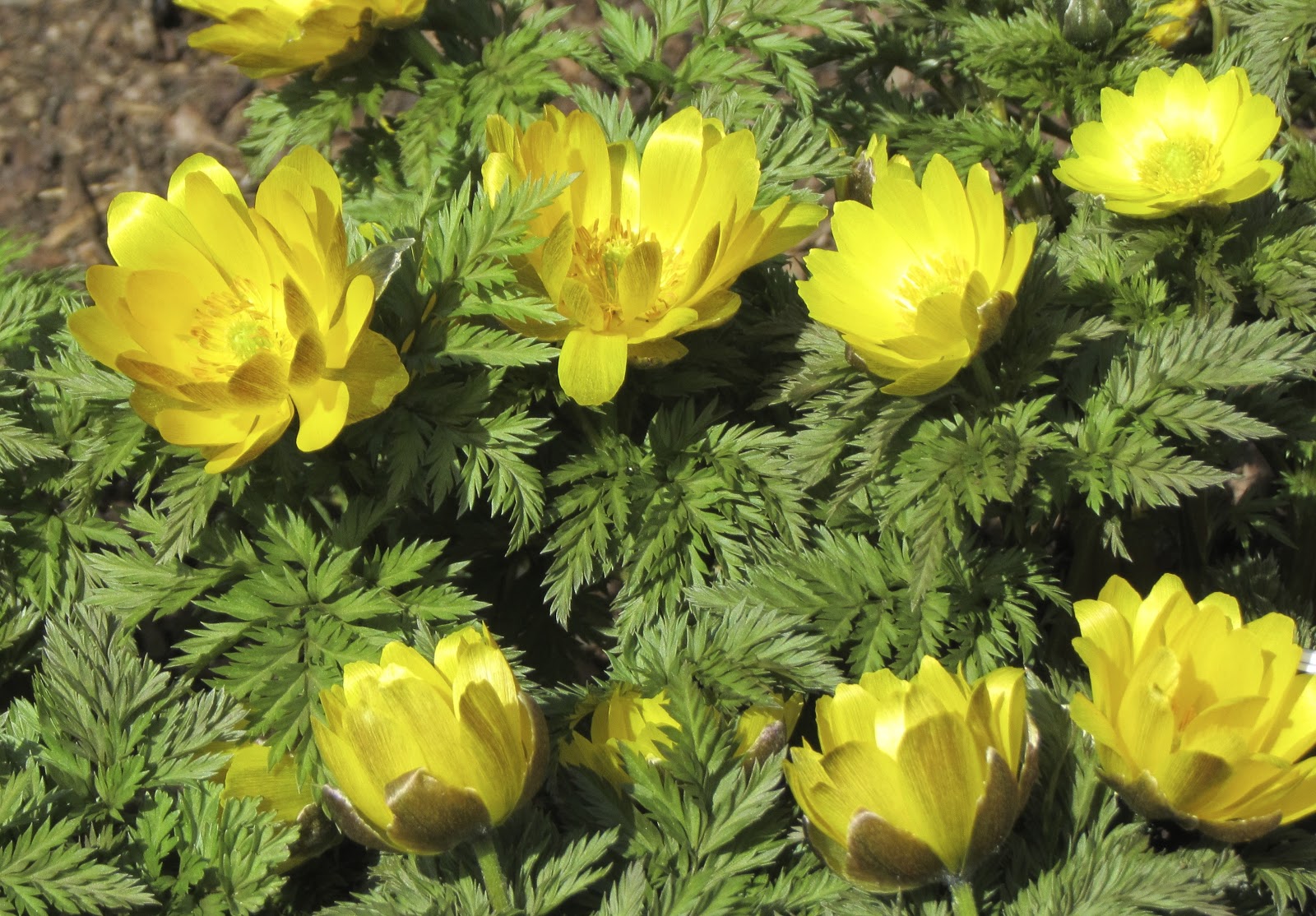
Adonis Flower

Even though the temperature was only 33 degrees Fahrenheit yesterday morning, this yellow-flowering early spring perennial has been in blossom for some time now. There are numerous plants named 'adonis' and they bring to mind the Greek myth of the beautiful youth who was killed by a boar. Flowers sprang from he spot where his blood touched the earth. The flowers of myth are red but many yellow flowers celebrate a return to life each spring.